|
When a civilization sets itself on a decisive course, the results can be astounding. In the renaissance, the West set itself on science. Now, nations rendezvous in space, machines talk to each other across the globe, and human beings live twice as long as their forefathers.
From 779, when Buddhism became the state religion of Tibet, until 1959, when its civilization was crushed by the Chinese army, Tibet set itself single-mindedly on spiritual development. Tibets music and art were inspired by meditation and designed to aid it. Her popular heroes were meditators, not ball players or movie stars. Cities erected statues of Buddhas, not soldiers. Great monastic universities the largest housed ten thousand teachers and students taught the theory, practice, and history of human spiritual development.
In Lhasa, Tibets capital, two schools ranked among the best of the best. Specializing solely in tantric meditation the quick path to enlightenment these small, elite institutions were demanding, even by Tibetan standards. To ensure a lifetime of committed practice, students typically enrolled as teenagers. For a student over 30 to be admitted, he first had to have a doctoral degree from another monastic university in itself a 20-to-30 year program.
Located on the north side of Lhasa, Gyuto, or Upper (Lhasa)Tantric (University) was founded in 1474 by Jey Kunga Dondrub, a leading disciple of H. H. the First Dalai Lama. Starting with just 32 monks, by 1959, Gyuto had 900. When the Chinese invaded, only 90 of them were able to follow H. H. the Fourteenth Dalai Lama into exile.
Gyuto soon found a home in northern India and expanded rapidly. Since the 1987 Chinese crackdown in Tibet, however, so many new refugees have flooded into India and Gyuto that the University has outgrown its small facility. A new monastery is now built in Dharamsala, India, for the 370 monks who now are part of Gyuto. It is to raise funds to feed and house these new students that the monks have left their mountain hermitage to bring their ancient traditions to America.
2500 years ago, the Buddha sat under a tree outside a small town in Northern India and achieved enlightenment. In the twenty-five centuries since, Buddhists have developed innumerable meditation systems based on his earth-shaking experience. The most difficult and effective, Tibetans say, are found in books called tantras.
The tantras describe not just one Buddha, but thousands. Tibetans believe that every living being has the potential to achieve enlightenment. The vast number of tantric deities reflect the infinite variety of human temperaments and cultural conditions. Focusing on his or her own potential for enlightenment, a tantric meditator visualizes that he or she is one of these Buddhas. Such a Buddha is called a yidam, tutelary or archetype deity. By harnessing ones own self-image through mediating on a yidam, the tantric path aims at turning the deepest recesses of the psyche into an engine of enlightenment. Tampering with the foundation of the psyche can be dangerous, though Tibetans do not practice tantric meditation without the guidance of an accomplished teacher. Training such highly skilled professionals, in fact, is the central goal of Gyuto Tantric University.
____________________________________________________________
The monks of Gyuto have perfected a special type of chant in which each monk sings not a single note but an entire chord. This remarkable, transcendentally beautiful sound, notes Robert Thurman, Chair of the Dept. of Religion, Columbia University, is thought to arise only from the throat of a person whohas realized selfless wisdom.
|
|
Some people may ask Why are they performing publicly what should be esoteric rites? Perhaps these people feel that secret teachings should not be turned into a theatrical spectacle. But they need not be concerned. The secret interior path and its processes are things which the ordinary eye cannot perceive. H.H. The Dalai Lama
|
____________________________________________________________
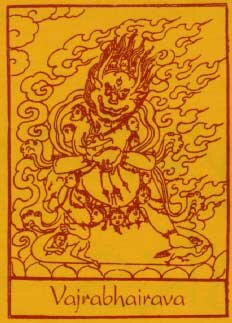
Vajrabhairava is one of the main yidam or tutelary deities, not only of Gyuto Tantric University, but of the Gelukpa monastic order to which Gyuto belongs. Vajrabhairavas name means Diamond Terrifier (Tibetan, Dorje Jikche). His bull-like face indicates that he has overcome Yama, the bull-headed Lord of Death. From the top of his head, emerges the small peaceful face of Mañjushri, who embodies all the wisdom of all the Buddhas; Vaj-rabhairava symbolizes that wisdom transcends death.
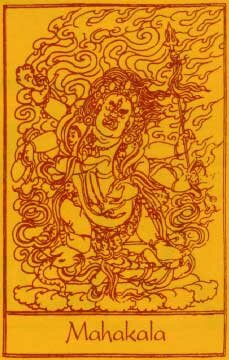
When a meditator has learned to develop his own Buddha-nature through meditation on Vajra-bhairava or similar Buddhas, he or she can begin to tackle more dangerous forces. Legend has it that the Buddhas and other great spiritual heroes of old conquered many such forces and converted them into protectors of the Buddhas teaching. Some see the protectors as supernatural beings, others see them as psychological forces: for the Tibetans, they often seem to be a bit of both. Mahakala The Great Black One is the chief of the Protectors. In the Mahakala ceremony, the monks invite the great protector to manifest himself. They then lavish gifts and praise on him. Reminding him of the promises he has made to Buddhas past, the monks commission Mahakala to nurture their spiritual practices and to protect the earth and all beings who live on it.
|


